Art Education
My work was formed at the intersection of decorative and applied and academic fields. Having started my studies in decorative and applied arts, I learned the basics of form, rhythm and decorative stylization early on. However, the desire for deeper visual expression and exploration of human nature led to a transition into the field of fine art.
This change of direction became a turning point, opening the way to the development of academic thinking and artistic vision.
Each series of works is a logical continuation of the previous one, creating a single trajectory of artistic development.:
Still lifes are one of the first works in which the artist explores the structure and rhythm of the surrounding world. Careful work on the composition, tone and materials allows you to feel the object and the atmosphere. These works became a starting point for observation and understanding.
Plaster heads and educational sketches are an important stage of academic education. In these works, one can trace the rigor of form, attention to proportions and the transfer of volume through light and shadow. These works not only demonstrate technical training, but also lay the foundation for future free expression.
Linear-constructive drawings reflect the analytical approach of the artist. In these works, a figure or an object is analyzed as an architectural structure. In them, one can see the inner logic of form, an understanding of perspective and spatial thinking.
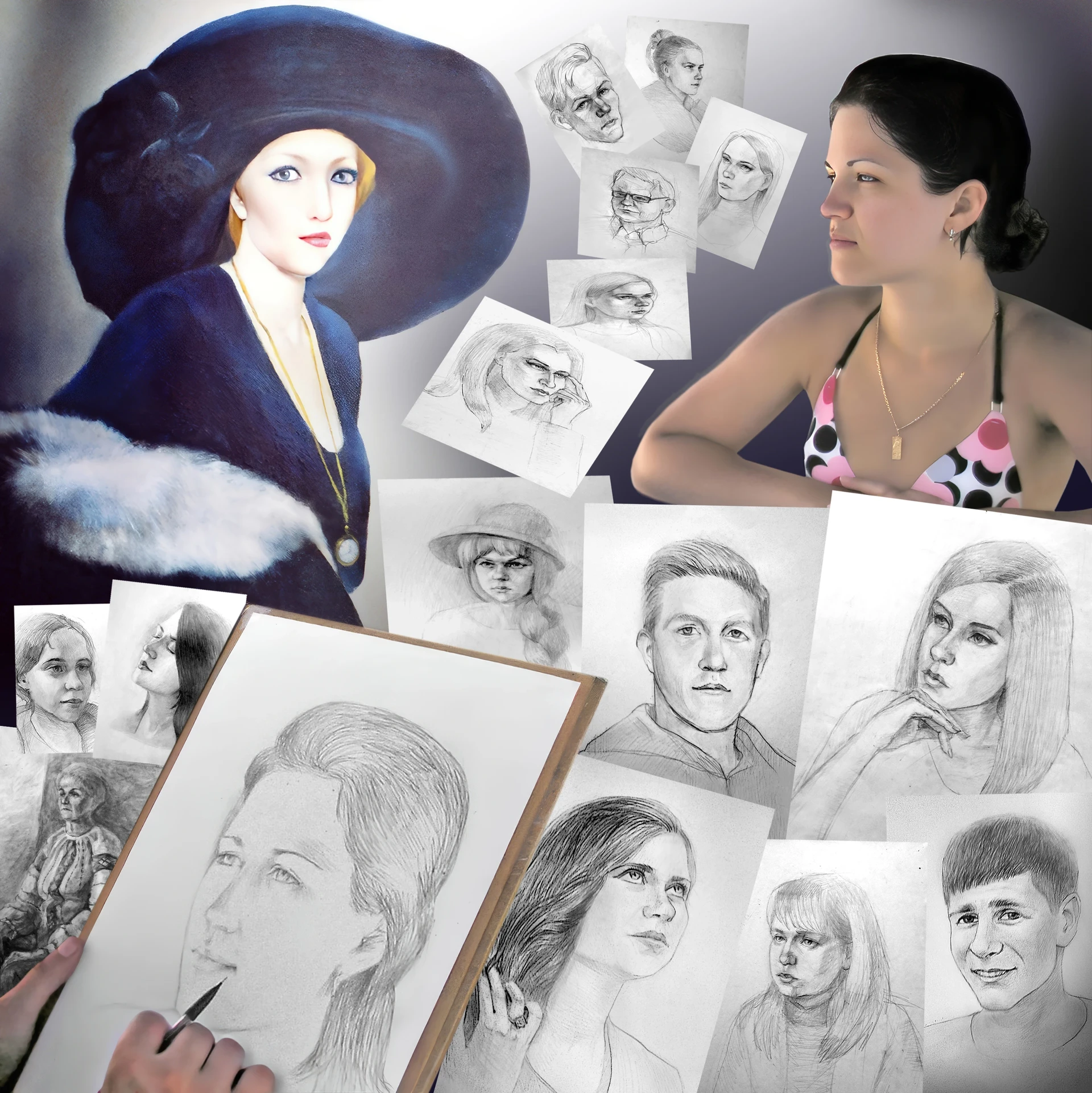
Portraits in graphics and oil are an important part of the artist's creative path. These works go beyond the scope of educational tasks: they feel the search for character, emotional state and depth of the inner world. The portrait becomes a dialogue between the artist and the model.
Landscapes and sketches are the most personal and mood—free works. Painted from nature, they are filled with freshness and attention to light and atmosphere. Landscapes serve as a space where the artist explores color, air, the state of nature and his own feelings in the moment.